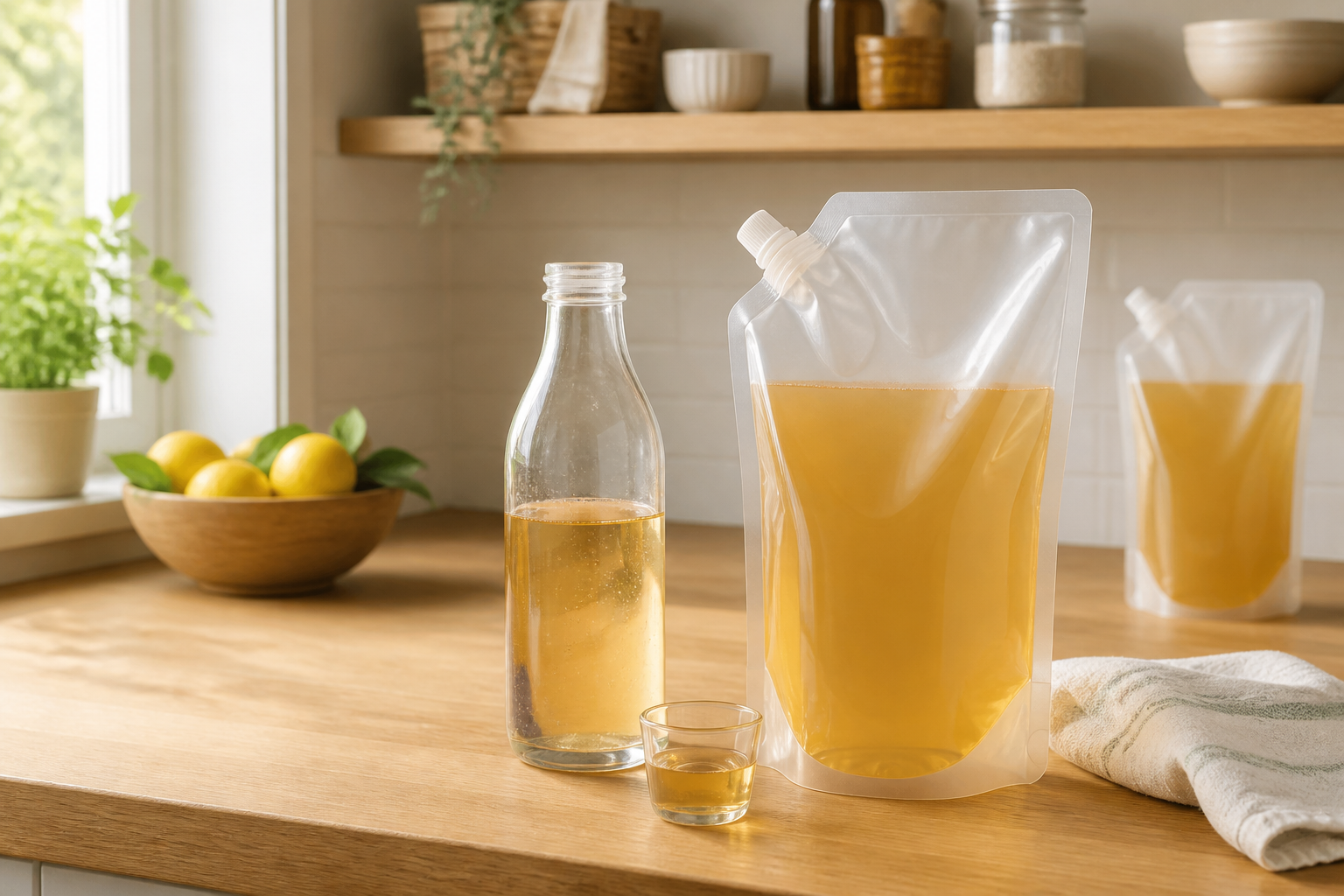
Liquid refill packaging appears in ordinary kitchen moments. A pouch may be opened to replenish a bottle, a small pack may be stored for a later meal, and a family-size refill may sit beside other pantry supplies. These actions turn packaging into part of the household routine, not simply a container selected after the product is defined.
For a packaging team, the useful question is how the liquid will be poured, stored and used after purchase. Water, cooking oil, juice, liquid seasoning and sauce can have different flow behavior and handling needs. The package format should connect those product characteristics with a filling and sealing workflow that can be reviewed through representative samples.
Start with the refill moment
Describe the moment when the customer uses the pack. A refill pouch may be lifted from a kitchen shelf, opened above a reusable bottle and returned to a cupboard. A smaller liquid sachet may be used beside a lunch preparation area, while a larger pouch may be kept for several household uses. Each routine affects grip, opening size, pouring direction and storage position.
Write down where the package is handled and whether it is used in one pour or several. This simple observation helps define whether the pack should stand upright, lie in a storage bin or remain easy to hold with one hand.
Choose a format for pouring and storage
A refill package needs a stable shape when it is placed on a counter and a manageable profile when it is stored. A stand-up pouch can support upright pantry storage, while a flat sachet can suit a smaller single-use portion. A gusseted or wider-base format may be considered when the filled pack needs more support during handling.
Opening features should be assessed with the pouring action. A tear notch, spout area or resealing feature changes how the user controls the liquid and closes the remaining pack. The decision should also consider whether the package will be poured into a bottle, measured into a bowl or used directly during cooking.
Match material and sealing to the liquid
Liquid products can differ in viscosity, particle content, aroma and sensitivity to the surrounding environment. Water-like products, oils, juices and sauces may therefore require different film, seal and filling discussions. The material should be reviewed with the expected storage conditions and the way the package will be handled after opening.
Seals also deserve practical attention. A clean seal supports storage confidence, while a suitable seal position can make the pack easier to grip and pour. Sample testing can help review leakage risk, package stability and the amount of liquid left around the opening after use without relying on assumptions from a general product category.
Connect the package with liquid filling equipment
The package decision influences the filling and sealing workflow. Product flow, viscosity, target fill, film width and bag length all need to be discussed together. Cleaning access and changeover requirements matter as well, especially when a line may handle more than one liquid application.
Huapai Machinery's liquid packing machine range provides a relevant starting point for comparing liquid application options. The final configuration should be checked against the actual liquid, packaging film, fill requirement and intended refill routine.
Test the package in the kitchen
Representative samples should be tested in the place where the customer will use them. Fill the chosen film, place the pack on a counter, pour into the intended bottle or container and return the remaining pack to its storage position. Observe how easy it is to hold, open, control and close. This connects the packaging review to a real kitchen decision rather than an isolated machine discussion.
- Describe the liquid flow, viscosity and any particles or settling behavior.
- Define the refill destination, target fill and opening frequency.
- Share the storage position, carrying route and expected handling.
- Review film tracking, sealing, cleaning and changeover needs.
- Record pouring and storage observations from the intended home routine.
Conclusion
Liquid refill packaging becomes easier to evaluate when the kitchen routine is considered from the beginning. By connecting pouring, storage, opening, material behavior and sealing with the filling workflow, packaging teams can make a clearer decision about the pack format before equipment is configured. The final review should reflect how the customer will hold and use the refill, not only how the empty film looks on a drawing.
← Back to News