Sauce Packing Machine Selection for Ketchup, Chili Sauce and Paste
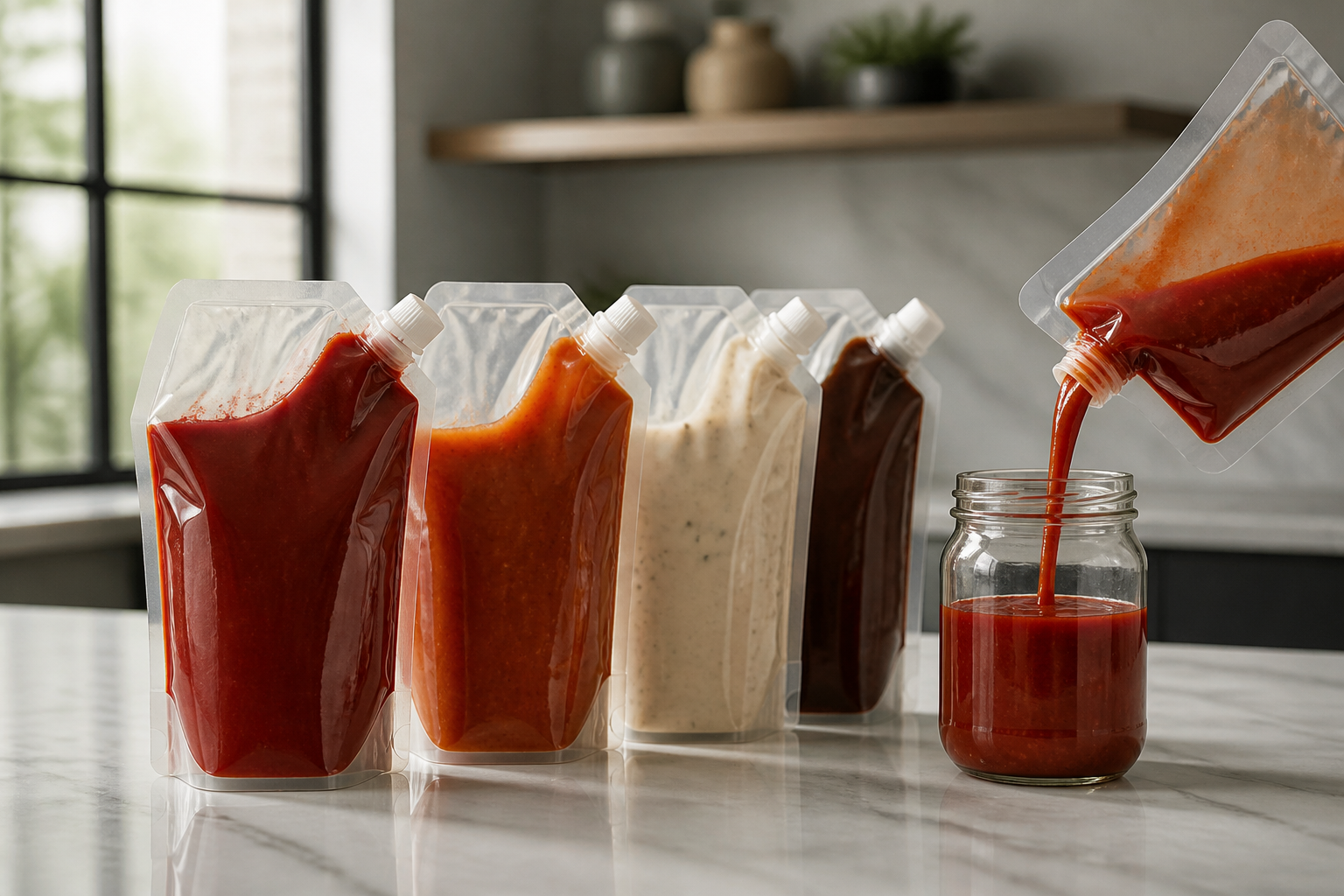
A sauce packing machine should be selected from the finished ketchup, chili sauce, tomato paste or condiment formulation rather than a household refill routine. Viscosity, temperature, suspended particles, oil separation and target fill volume all affect the filling route, pouch support and sealing process. A production brief should define the actual sauce and approved package before equipment is configured.
Review sauce flow, temperature and particles
Tomato sauce can flow differently when the formulation, temperature or particle content changes. Thick pastes may need a filling configuration that can move the product consistently, while sauces with seeds, fiber or inclusions require a sample review to confirm product passage and fill behavior. Representative material should be evaluated for hopper flow, dosing stability and clearance at the final seal area.
Keep the seal area clear during filling
Product carried into the seal zone can affect closure appearance and package integrity. Confirm the target fill level, pouch support, product cut-off behavior and required headspace with the actual sauce. A sample run should check that the pouch remains stable during filling and that the selected seal stays clear of sauce before the finished package is approved.
Choose the pouch and sealing route
Three-side-seal sachets, back-seal bags and premade pouches are different production routes. Small condiment portions may use a sachet format, while larger refill packs may use stand-up or spouted premade pouches. The choice should follow the approved pouch, fill volume, opening feature and sealing requirement; roll-film forming equipment and premade-pouch equipment should not be treated as interchangeable.
Match the sauce to documented Huapai configurations
The sauce packing machine range lists configurations for viscous products including ketchup, chili sauce, jam and paste. For small sachets, the published HP-S25 configuration is listed for 5–25 ml and 10–25 pcs/min. The HP-S50 is listed for mixing sauce at 10–50 ml and 8–16 pcs/min, while the HP-S100 is listed for paste/sauce at 10–100 ml and 6–14 pcs/min with a piston-pump tag. These published ranges are selection references; the actual sauce sample and bag specification must confirm the final configuration.
For stand-up or larger pouch projects, the same range lists the HP-S500 as a premade-pouch configuration for 100–500 ml at 6–10 pcs/min. Review the premade pouch packing machine range when the approved sauce package is a ready-made pouch. A liquid route can be appropriate only when the product viscosity and filling requirement fit its documented application; compare the liquid packing machine range with the sauce requirement rather than applying a thin-liquid configuration to every paste.
Plan food-contact cleaning and changeover
For condiment production, cleaning access, batch changeover and the food-contact construction required by the project belong in the equipment review. Confirm the actual process, sauce formulation and cleaning method with the supplier. Avoid assuming that a feature or configuration applies before it is documented for the selected model.
Prepare a sauce packaging inquiry
- Provide the finished ketchup, chili sauce, tomato paste or condiment sample.
- State viscosity, particles, product temperature, target fill volume and production requirement.
- Specify bag style, pouch dimensions, film or pouch construction, opening feature and sealing format.
- Validate filling, seal-area cleanliness, pouch support and finished-pack handling with a representative run.
Conclusion
Sauce packaging is a material-specific filling and pouch-selection application. The final configuration should follow the tested sauce behavior, documented machine boundary, approved bag format and sealing requirement.
← Back to News