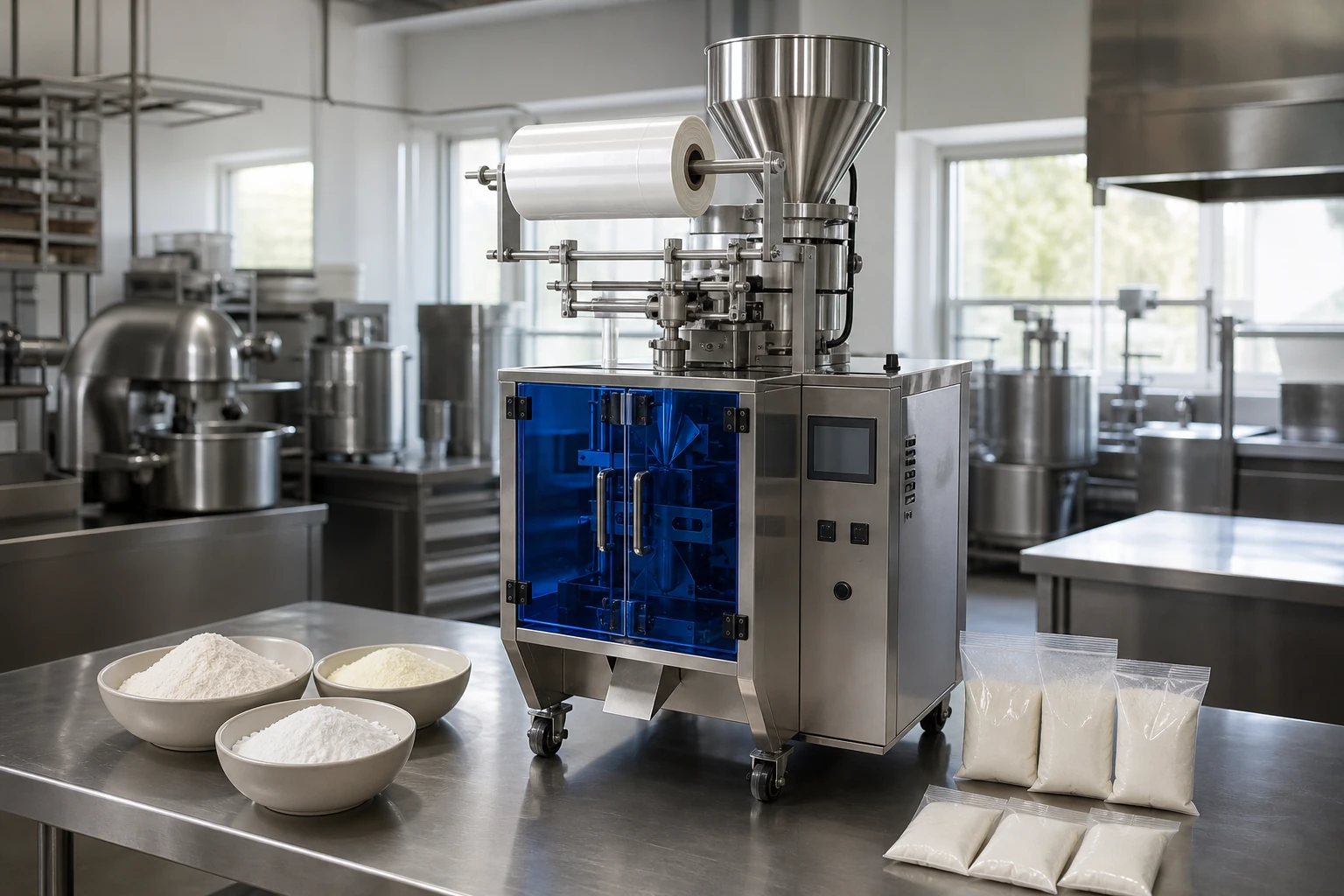
For manufacturers packing small portions of flour, milk powder, powdered sugar, seasoning powders, and other dry powdered products, the packaging process needs to balance several practical requirements: accurate portioning, compact bag sizes, reliable sealing, easy operation, and efficient use of production space.
These requirements become particularly important when the target filling weight is only a few grams to 100 grams per bag. Manual weighing and sealing may be suitable for very small production volumes, but as daily output increases, repeated weighing, filling, sealing, and cutting can require considerable operator time.
The HP-PTP0520 (C) small powder packing machine from Huapai Machinery is designed for 1–100g powder packaging applications. It combines product filling, roll-film bag forming, sealing, and cutting in one compact automatic packaging system.
With a standard packing speed of 25–40 bags per minute, a listed filling accuracy of ±1g, and support for both three-side seal and back-seal bags, the HP-PTP0520 (C) provides a practical packaging option for small and medium-sized powder products within our line of automatic powder and granule packing machines.
This article introduces the machine's applications, bag formats, operating process, technical specifications, optional functions, and the information customers should prepare before selecting a powder packaging machine.
What Is the HP-PTP0520 (C) Designed to Package?
The HP-PTP0520 (C) is mainly intended for small portions of compatible dry powder materials.
Typical applications include:
- Flour
- Milk powder
- Powdered sugar
- Seasoning powder
- Beverage powder
- Baking ingredients
- Dry food powders
- Similar powdered materials
The standard packing range is 1–100g per bag, making the machine suitable for single-use sachets, sample packs, portion-controlled ingredients, and small retail packages.
For example, a producer may need to package a small amount of seasoning powder for one cooking application, a portion of milk powder for a single drink, or a compact package of powdered sugar for bakery use.
Although these products are all powders, their physical characteristics can be very different. Flour may be relatively light and dusty, powdered sugar may have a different bulk density, and milk powder may flow differently again. Because of these differences, the same filling weight does not always require the same bag volume. This is why machine selection should consider both target weight and actual product characteristics.
Why Small Powder Packaging Requires the Right Machine Configuration
Packing 1–100g of powder may appear straightforward, but small-dose packaging requires good coordination between product filling, film movement, bag dimensions, and sealing.
One important consideration is bulk density. A 50g portion of one powder can occupy considerably more space than 50g of another. If the finished bag is too small, the product may approach the sealing area and interfere with package formation. If the bag is unnecessarily large, the finished package may not match the customer's presentation requirements.
Powder flow is another consideration. Some powders move easily through the feeding system, while others may be lighter, finer, or more prone to dust generation.
For this reason, customers should provide the actual product information before finalizing the machine configuration. Useful information can include:
- Product name
- Product photos or video
- Target filling weight
- Approximate product density
- Bag dimensions
- Required bag style
- Packaging film information
When possible, testing with the actual product provides an even clearer reference.
1–100g Packaging Range for Small Portions
The HP-PTP0520 (C) has a specified packing range of 1–100g. This range covers many common small-package applications. Examples may include:
- 5–15g: seasoning powders, powdered ingredients, sample portions
- 20–40g: milk powder, beverage powders, baking ingredients
- 50–100g: flour, powdered sugar, premixed powders, and larger portion packs
These examples are intended only as general references. The appropriate bag size and machine setting still depend on the actual product.
The listed machine accuracy is ±1g. Actual filling performance can vary depending on powder characteristics, target weight, machine adjustments, and operating conditions. For products with strict weight requirements, testing with the actual material is recommended before production.
Three-Side Seal and Back-Seal Packaging Options
Different products and brands may require different finished bag appearances. The HP-PTP0520 (C) supports both Three-side sealing and Back sealing. These two bag formats are widely used for small powder packages.
Three-Side Seal Sachets
Three-side seal packaging creates a relatively flat, rectangular sachet. This style is suitable for compact powder portions and provides a clean package appearance. It can be considered for products such as:
- Seasoning powder
- Powdered sugar
- Drink powder
- Milk powder
- Small ingredient portions
The flatter shape can also make individual sachets convenient for grouping inside cartons or larger outer packages.
Back-Seal Bags
Back-seal packaging forms a longitudinal seal along the rear of the package together with top and bottom seals. This format is also commonly referred to as a pillow-style package.
Back-seal bags are frequently used for powders and other dry materials because they can be produced continuously from roll film and provide useful internal volume.
The right format depends on the customer's preferred package appearance, filling amount, product volume, and film design.
Adjustable Bag Length for Different Packaging Requirements
The HP-PTP0520 (C) uses roll film to form individual packages. The current reference configuration includes:
- Film width: 15cm, pre-factory setting
- Bag width: 7.5cm, pre-factory setting
- Bag length: 3–15cm, adjustable during use
The bag length can therefore be adjusted according to different portion requirements within the machine's applicable range.
The 15cm film width and 7.5cm finished bag width are reference factory settings for the current configuration. Customers requiring another package specification should confirm the desired dimensions before ordering. Providing an existing bag sample, drawing, or clear measurements can help confirm whether the machine configuration matches the project.
How the Automatic Powder Packaging Process Works
The HP-PTP0520 (C) combines the main packaging operations into a continuous process:
- Product Supply: The dry powder is supplied to the machine's product-feeding section. The machine is adjusted according to the target filling requirement.
- Film Feeding: Packaging film is installed on the machine and guided through the film-feeding system. During operation, the film moves toward the forming section.
- Bag Forming: The flat roll film is shaped into the required packaging form. The exact sealing arrangement depends on whether the machine is configured for three-side seal or back-seal packaging.
- Product Filling: The preset powder portion is discharged into the formed package. The filling settings should correspond to the actual product and required weight.
- Sealing: The package is heat sealed according to the selected bag format. Suitable sealing settings depend on the packaging film being used.
- Cutting: Once the bag reaches the preset length and sealing cycle is complete, the finished package is separated. The next packaging cycle then continues automatically.
By integrating these operations, the machine reduces the need to weigh, fill, position, seal, and cut each individual package manually.
Packing Speed of 25–40 Bags per Minute
The listed packing speed of the HP-PTP0520 (C) is 25–40 pcs/min.
Actual production speed depends on several factors, including:
- Filling weight
- Product flow characteristics
- Bag length
- Packaging film
- Sealing conditions
- Machine settings
For example, a small sachet containing a relatively free-flowing powder may operate differently from a larger 100g package containing a lighter product. Because of this, speed should be considered together with stable filling and finished-package quality rather than as an isolated number.
For small and medium-sized businesses moving away from manual packaging, the machine provides automatic continuous packaging within a relatively compact equipment footprint, comparable to our compact HP-TP0520 packaging solutions.
Optional Cursor Locator and Code Printer
Many commercial products use printed packaging film rather than plain transparent film.
The HP-PTP0520 (C) can be equipped with an optional cursor locator, also used for photoelectric registration. When suitable printed film includes registration marks, the system detects these marks during film feeding and helps coordinate the package cutting position with the printed design. This is useful for packages containing product names, brand graphics, ingredients, barcodes, and usage instructions.
Customers planning to use printed film should provide the packaging film specifications or sample where possible. Film compatibility and sealing conditions should be confirmed according to the actual packaging application.
A code printer is another optional configuration for the HP-PTP0520 (C). Depending on the selected coding arrangement, it can be used to add production-related information to the package, such as production date, batch information, and expiration details.
Electric and Pneumatic Driving System
The HP-PTP0520 (C) uses an electric and pneumatic driving system. Its listed electrical specifications are:
- Voltage: 230V / 110V
- Frequency: 50 / 60Hz
- Working power: 1050W
The plug type can be customized according to customer requirements. This is particularly relevant for overseas customers because local electrical standards vary between countries and regions. Before shipment, customers should confirm their required voltage, frequency, and plug type. The installation environment should also meet the pneumatic requirements of the final machine configuration.
Compact Size for Smaller Production Areas
Another practical characteristic of the HP-PTP0520 (C) is its compact machine size:
- Machine dimensions: 53 × 46 × 160 cm
- Net weight: 88 kg
- Shipping dimensions: 55 × 66 × 185 cm
- Gross weight: 118 kg
The relatively narrow footprint makes the machine suitable for production areas where available floor space is limited. It may be considered by small food manufacturers, bakery ingredient producers, seasoning manufacturers, powder product businesses, contract packaging workshops, and startup production facilities handling smaller production batches.
HP-PTP0520 (C) Technical Specifications
| Model | HP-PTP0520 (C) |
|---|---|
| Packing Range | 1–100g |
| Accuracy | ±1g |
| Packing Speed | 25–40 pcs/min |
| Voltage | 230V / 110V |
| Frequency | 50 / 60Hz |
| Working Power | 1050W |
| Plug Type | Customized according to customer requirements |
| Machine Size | 53 × 46 × 160 cm |
| Net Weight | 88 kg |
| Packing Size | 55 × 66 × 185 cm |
| Gross Weight | 118 kg |
| Film Width | 15 cm, pre-factory setting |
| Bag Width | 7.5 cm, pre-factory setting |
| Bag Length | 3–15 cm, adjustable during use |
| Bag Style | Three-side seal / Back seal |
| Optional Functions | Cursor locator / Code printer |
| Drive Type | Electric + Pneumatic |
| Typical Applications | Flour, milk powder, powdered sugar and other compatible dry powders |
Actual packaging performance should be confirmed according to the specific product, filling weight, packaging film, and operating settings.
What Information Should Customers Provide Before Ordering?
Selecting a powder packing machine should begin with the product rather than only the machine model. Before confirming the HP-PTP0520 (C), customers are encouraged to provide:
- Product: What powder needs to be packed?
- Filling Weight: How many grams per bag?
- Bag Width: What finished width is required?
- Bag Length: What finished length is required?
- Bag Style: Three-side seal or back seal?
- Packaging Film: Printed or unprinted film?
- Coding Requirement: Is date or batch coding required?
- Electrical Standard: 110V or 230V, 50Hz or 60Hz?
- Target Output: What production capacity is required?
Product photos and packaging samples can also make communication easier. If the material has unusual flow characteristics, testing actual samples before final configuration is especially useful.
Machine Testing Before Delivery
Before shipment, the packaging machine can be tested according to the agreed project requirements and available test materials. The test can cover the main production steps, including:
- Product feeding
- Filling
- Film feeding
- Bag forming
- Sealing
- Cutting
- Finished-package appearance
A machine test helps confirm that the selected configuration is suitable for the intended packaging format. For international customers, test videos can also provide a practical way to review machine operation before shipment.
Is the HP-PTP0520 (C) Suitable for Your Powder Product?
The HP-PTP0520 (C) is intended for businesses requiring compact automatic packaging of 1–100g dry powder portions. Its combination of a small footprint, automatic roll-film packaging, adjustable bag length, three-side seal and back-seal options, and optional registration and coding functions makes it suitable for a range of small powder packaging projects.
However, the correct machine configuration should always be based on the actual material and package. Flour, milk powder, powdered sugar, seasoning powder, and other dry powders can have different densities and flow characteristics, so providing product information before ordering is an important step.
If you are planning a small powder packaging project, send Huapai Machinery your product, filling weight, bag dimensions, bag style, and packaging requirements. Our team can use this information to confirm whether the HP-PTP0520 (C) matches your application and prepare the appropriate machine configuration.
Planning a 1–100g Powder Packaging Project?
Share your powder material, target filling weight, bag dimensions, and preferred sealing style with the Huapai Machinery team.
Contact Huapai Machinery to Discuss Your Application