 HUAPAI
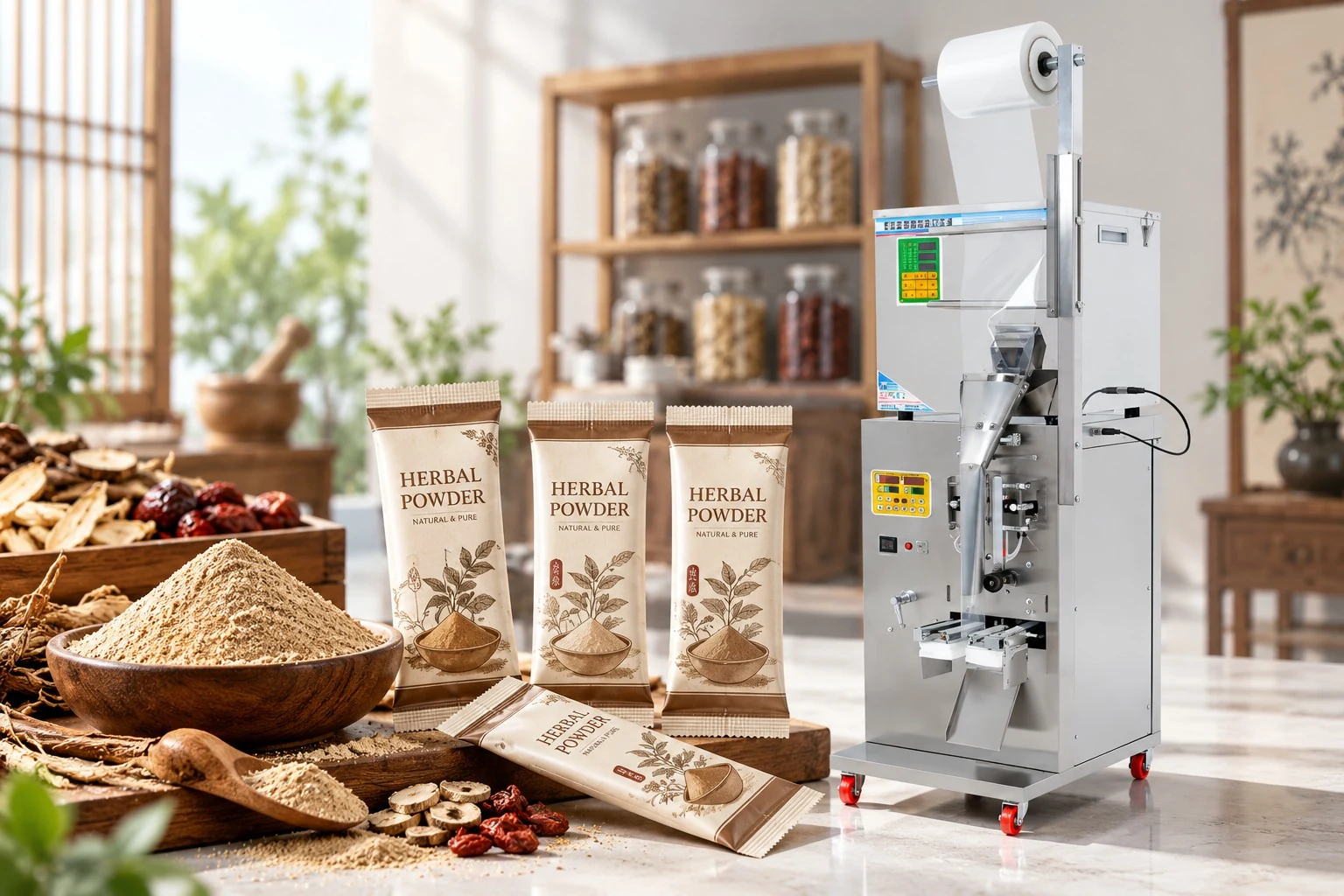
Packaging traditional Chinese medicine (TCM) powder, micro-pulverized herbal extracts, health botanical supplements, and medicinal root powders requires rigorous process control. Unlike coarse granules, herbal powders feature superfine particle distributions (typically 100–300 mesh), variable bulk densities, and high susceptibility to ambient moisture and static cling. Moreover, pharmaceutical and dietary supplement standards demand stringent hygiene, precise single-dose metering, and zero cross-contamination.
Vertical Form-Fill-Seal (VFFS) powder packaging machines equipped with servo-driven vertical auger fillers provide an automated, enclosed, and highly repeatable packaging workflow. This technical guide outlines the primary powder handling challenges, continuous bag forming and pneumatic sealing principles, sanitary design features, and multi-layer barrier film structures based on empirical testing in the Huapai Machinery manufacturing facility.
1. Application Pain Points in Chinese Herbal Medicine & Botanical Powder Packaging
Packaging ultrafine herbal and medicinal powders presents critical mechanical and biochemical considerations that production engineers must systematically resolve:
- Severe Airborne Dust & Sealing Seam Contamination: Ultrafine pulverized botanicals readily aerosolize upon rapid gravity discharge. Suspended powder settling on the longitudinal or cross-seal heat margins prevents complete polymer fusion, causing micro-channel leakage and compromised package sterility.
- Hygroscopic Clumping & Bridging in Hoppers: Many herbal extract powders are naturally hygroscopic. As relative humidity fluctuates, the powder tends to compact or form bridges above the discharge throat, leading to intermittent starvation of the dosing screw and inconsistent fill weights.
- Static Electricity & Film Cling: Non-conductive flexible plastic packaging films generate electrostatic charges during continuous unwinding and collar forming. Dry herbal particles cling to the internal tube walls, leading to powder trailing into the transverse cut zone.
- Volatile Aroma & Active Phytochemical Oxidation: Bioactive polyphenols, flavonoids, and volatile essential oils degrade rapidly when exposed to oxygen and moisture. The packaging process must maintain gas-tight seal integrity to extend product shelf life.
2. Factory Video: Real-World Vertical Dosing, Sachet Forming & Pneumatic Sealing Sequence
The operational video below captures a continuous vertical form-fill-seal herbal powder packaging machine during factory acceptance validation at Huapai Machinery. Roll-stock barrier film passes through a precision forming collar to construct a continuous tubular sleeve. The vertical servo auger meters calibrated doses of fine herbal powder through the central filling lance directly into the newly formed pouch, followed by precision pneumatic sealing and synchronous cutoff.
Key technical observations during the operational test include smooth vertical film indexing, immediate cutoff of the powder stream without residual dripping, and crisp, hermetic pillow sachets discharged onto the takeaway chute.
3. Step-by-Step Working Principle of Vertical Herbal Powder Form-Fill-Seal Machine
- Continuous Film Unreeling & Optical Registration: The roll-stock flexible laminate unrolls smoothly from the rear pneumatic shaft. An integrated dancer arm maintains uniform web tension, while high-sensitivity optical sensors read printed eye marks to govern exact pouch length indexing.
- Tube Forming Around Collar & Mandrel: The flat film is guided over a mirror-polished 304 stainless steel forming collar, folding progressively into a vertical cylindrical tube with a controlled longitudinal overlap.
- Longitudinal Back-Seam Thermal Fusion: A vertically mounted, temperature-regulated seal bar presses against the overlapped film edge, applying calibrated heat and mechanical pressure to form a continuous center-back fin or lap seal.
- Servo Auger Metering & Submerged Discharge: In the upper cone hopper, an independent slow-speed agitator breaks powder bridges while a high-torque servo motor drives the precision ground vertical auger screw. The exact volume of herbal powder is conveyed downward through the inner discharge lance deep into the lower pouch body.
- Transverse Horizontal Sealing, Cooling & Knife Cutoff: Opposed horizontal sealing jaws close synchronously to form the hermetic top seal of the filled sachet and the bottom seal of the succeeding pouch. An integrated serrated pneumatic blade severs the sachet, cleanly dropping the finished package onto the output conveyor.
Synchronizing the servo screw rotation angle with the intermittent opening of the transverse sealing carriage ensures zero powder ingress into the heat-affected seal zone.
4. Sanitary Stainless Construction, Anti-Bridging Agitation & Hermetic Seal Engineering
Compliance with pharmaceutical, dietary supplement, and food safety standards requires specialized mechanical execution throughout the product contact pathway:
Sanitary SUS304 / SUS316 Contact Surfaces: All product contact modules, including the storage hopper, internal agitation paddles, vertical auger screw, and forming mandrel, are constructed from food-grade SUS304 or optional SUS316 stainless steel with mirror-polished interior finishes (Ra < 0.4 μm) to prevent residue buildup and simplify clean-in-place (CIP) washdowns.
Dual-Drive Independent Agitation System: The conical hopper integrates an independently driven slow-speed scraping agitator that rotates counter to the auger screw. This keeps fine herbal powder in a continuous, fluidized state and eliminates air pockets that cause dosing fluctuations.
Precision Digital PID Thermal Control: Dual solid-state PID temperature controllers independently regulate the vertical and horizontal heating elements within ±1°C of setpoint. Contoured sealing faces with fine linear or cross-hatch serrations exert uniform pressure across multi-layer barrier laminates.
5. Sachet Formats, Barrier Film Laminates & Active Ingredient Preservation
Selecting the appropriate flexible packaging film structure and sachet configuration is vital to protect delicate botanical extracts from humidity and oxidation:
- Center-Back Pillow Sachets: The most economical, high-speed single-dose format for herbal teas, medicinal decoction powders, and dietary supplements (1g to 50g doses).
- 3-Side & 4-Side Seal Flat Sachets: Popular in clinical dispensing and OTC pharmaceutical packaging, offering flat display profiles and easy inclusion in multi-sachet carton boxes.
- Stick-Pack Formats: Slender, elongated sachets ideal for direct-to-mouth botanical granules or single-serve on-the-go beverage mixes.
- High-Barrier Aluminum Laminates (PET/AL/PE, Matt BOPP/VMPET/PE): Multi-layer foil structures that provide an absolute oxygen, moisture, and light transmission barrier to safeguard active phytochemicals over extended shelf lives.
- Composite Kraft Paper Laminates (Kraft/VMPET/PE): Combines a natural, herbal branding aesthetic with internal metallized moisture protection for specialty organic botanical powders.
6. General Technical Specifications for Herbal Powder Packaging Machine
| Applicable Products | Traditional Chinese medicine (TCM) powder, herbal extracts, botanical health supplements, dietary fiber powder, mushroom extracts, and fine spice blends. |
|---|---|
| Supported Packaging Formats | Vertical Form-Fill-Seal (VFFS) center back-seal pillow sachet, 3-side seal flat pouch, or 4-side seal packet. |
| Dosing Mechanism & Range | Vertical servo-driven auger metering screw with independent anti-bridging agitator; dosing range 1 g – 100 g (customizable up to 500 g). |
| Dosing Accuracy | ±1% (dependent on powder flowability, bulk density consistency, and mesh fineness). |
| Packaging Speed | 25 – 60 sachets/min (varies by fill volume, film thickness, and powder characteristics). |
| Contact Material | Sanitary SUS304 stainless steel standard (SUS316 available upon request for acidic or pharmaceutical formulations). |
| Control System | PLC central controller, full-color HMI touchscreen interface, optical eye-mark registration, and comprehensive fault diagnostics. |
| Utility Requirements | Single-Phase 220V / 3-Phase 380V (50/60 Hz); clean compressed air ≥ 0.6 MPa (0.3–0.5 m³/min). |
Exact production capacity and specifications depend on powder bulk density, particle mesh size, fill weight, and packaging film laminate structure.
7. Information to Prepare for a Customized Equipment Quotation
To receive an accurate engineering recommendation and customized commercial quotation for your herbal powder packaging line, preparing the following project specifications is recommended:
- Product details (herbal species, extract type, mesh fineness/particle size distribution, bulk density in g/cm³, and moisture level).
- Target fill weight per sachet (e.g., 2g, 5g, 10g, 20g, 50g) and required dosing accuracy.
- Sachet style (center back-seal pillow sachet vs. 3-side / 4-side seal) and target flat bag dimensions (width × length).
- Packaging film structure (PET/AL/PE, PET/VMPET/PE, Kraft paper laminate) and film roll core diameter.
- Required production output (sachets per minute or daily batch volume goals).
- Factory electrical specifications (voltage, frequency, phase) and compressed air availability.
Explore our full range of powder & granule packing machines and premade pouch packaging systems, or contact our engineering specialists directly below.
Ready to Automate Your Herbal Powder Packaging Line?
Send your powder sample characteristics, target sachet dimensions, and output requirements to Huapai Machinery for an optimized engineering proposal and layout design.
Request Engineering Consultation