 HUAPAI
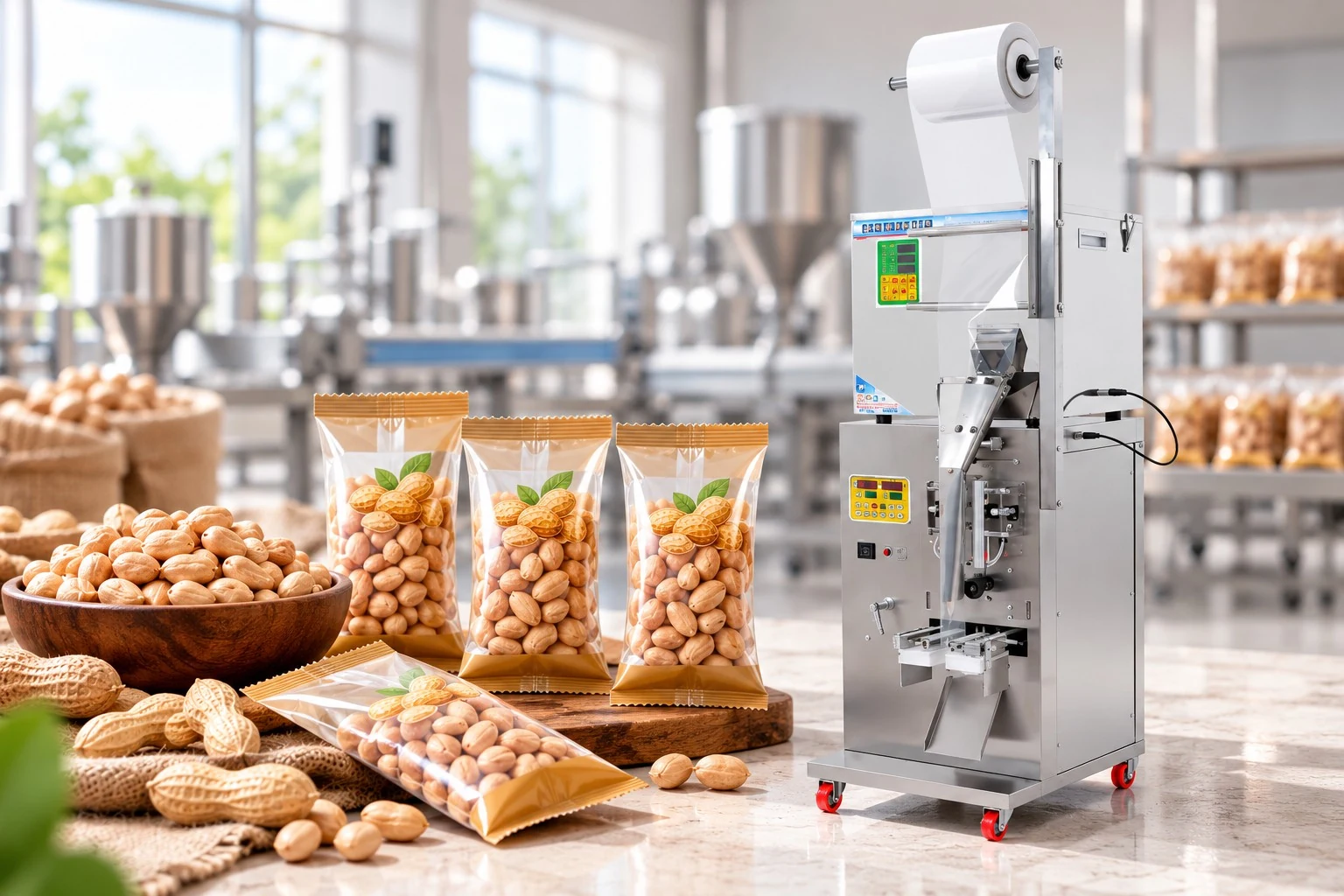
Packaging roasted peanuts, seasoned groundnuts, fried coated nuts, melon seeds, and mixed snack granules requires balancing weighing precision with delicate product handling. Peanuts and nut snacks contain high levels of unsaturated fats and delicate skins, making them susceptible to rapid oxidative rancidity when exposed to ambient moisture and atmospheric oxygen. Additionally, roasted nut kernels are brittle, demanding gentle feed paths to avoid breakage, crumbling, and cosmetic defects that degrade consumer value.
Vertical Form-Fill-Seal (VFFS) granule packaging machines equipped with microcomputer-controlled vibration feeders and electronic load-cell weighing hoppers provide an automated, high-accuracy, and cost-effective packaging solution. This engineering guide examines the primary handling hurdles in nut processing, continuous pillow pouch forming and sealing mechanics, gentle product transfer design, and high-barrier packaging film selection based on real-world factory commissioning at Huapai Machinery.
1. Application Pain Points in Peanut Snack & Roasted Nut Packaging
Industrial packaging lines for peanuts, tree nuts, and roasted seed snacks face specific mechanical and food preservation challenges that automated equipment must address:
- Kernel Breakage & Skin Flaking: Roasted and fried peanuts have delicate cellular structures. Harsh mechanical drops or violent vibration chutes can split whole kernels into fragments and strip red skins, creating excessive fines and reducing package grade.
- Lipid Oxidation & Rancidity Acceleration: High natural oil content makes nut snacks vulnerable to rancidity when packaged in oxygen-permeable or leaky pouches. Ensuring gas-tight hermetic seals and offering optional nitrogen flushing is essential for maintaining crisp texture and fresh roasted aroma.
- Seasoning & Salt Dust Interfacing on Heat Seals: Spiced, salted, or seasoned peanuts release fine particles during rapid descent. If seasoning dust or free oil settles onto the film margins, it can disrupt polymer fusion, causing micro-voids and seal failure.
- Piece Weight Variation & Bulk Density Shifts: Natural peanut kernels vary in kernel size, shape, and individual weight. Dosing systems must utilize multi-speed vibration feeding and smart electronic weighing to maintain tight batch weight tolerances without underfilling.
2. Factory Demonstration: Real-World Vertical Electronic Weighing & Pillow Pouch Packaging Sequence
The operational video below illustrates a continuous vertical form-fill-seal peanut and granule packaging machine undergoing factory acceptance testing at Huapai Machinery. Transparent flexible composite film is fed smoothly through an engineered forming collar into a continuous tubular profile. The upper microcomputer-controlled vibration dosing unit accurately meters single portions of whole roasted peanuts directly through the forming tube into the pouch, followed by pneumatic horizontal sealing and instantaneous cut-off.
Key observations from this production test include rapid, bounce-free product discharge, steady optical film tracking with zero lateral drift, and uniform, defect-free pillow sachets with sharp, hermetic end seals.
3. Step-by-Step Working Principle of Vertical Form-Fill-Seal (VFFS) Peanut Packaging Machine
- Automated Film Unreeling & Tension Regulation: Roll-stock packaging film unwinds continuously from the rear low-friction mandrel. Integrated tension control arms prevent slack and wrinkling, while photoelectric sensors register pre-printed eye marks to maintain precise bag cut lengths.
- Tubular Pouch Forming via Stainless Collar: The flat barrier film travels over a custom-machined 304 stainless steel forming shoulder, folding smoothly into a vertical tubular shape with a controlled longitudinal overlap.
- Continuous Vertical Back-Seam Fusion: A vertically aligned, PID-controlled heated sealing bar presses against the overlapped film edge, applying regulated thermal energy and constant pressure to create a strong center-back fin or lap seal.
- Two-Stage Vibration Dosing & Load-Cell Weighing: Peanuts from the upper storage hopper pass across dual-stage vibratory feed pans (coarse feed for rapid bulk volume, fine feed for precision trim). A high-precision strain-gauge load cell captures exact batch weight and triggers instantaneous gate release directly through the center forming tube.
- Horizontal Sealing, Cooling & Synchronous Separation: Opposed horizontal pneumatic sealing jaws close firmly to create the top seal of the filled sachet and the bottom seal of the next bag. An integrated hardened cutting knife cleanly severs the completed pouch, discharging it onto an inclined takeaway chute.
Synchronized timing between the weighing gate dump and the intermittent jaw opening ensures that nut kernels drop cleanly into the pouch cavity before the sealing cycle engages.
4. Sanitary SUS304 Construction, Anti-Crush Drop Channels & Hermetic Sealing Engineering
Meeting food processing sanitation standards and protecting fragile snack items requires specialized mechanical engineering throughout the entire material pathway:
Food-Grade SUS304 Product Contact Pathway: The product hopper, vibration feed troughs, weighing buckets, and former collar are manufactured from food-grade SUS304 stainless steel with smooth polished surfaces, preventing oil residue retention and facilitating rapid dry cleaning and sanitation.
Cushioned Anti-Crush Transition Angles: The discharge funnel and forming tube incorporate optimized slope angles and smooth transitional curves rather than steep vertical drops. This cushions kernel impact, substantially reducing skin peeling and kernel fracture during high-speed descent.
Independent Dual-Loop PID Thermal Regulation: Vertical back-seam and horizontal cross-seal jaws are controlled by separate digital PID temperature controllers accurate to ±1°C. Serrated sealing jaw profiles ensure consistent heat transfer across single-layer or multi-layer barrier laminates without film burn-through.
5. Pouch Formats, Nitrogen Gas Flushing & High-Barrier Laminate Selection
Selecting the optimal pouch geometry and film material structure is crucial for product branding, shelf presentation, and snack preservation:
- Pillow Pouch (Center Back-Seal): The most economical and high-speed packaging format for convenience-store snack portions, single-serve peanut packs (15g to 100g), and retail multi-packs.
- 3-Side / 4-Side Seal Flat Pouches: Compact, flat-laying packets suitable for airline hospitality snacks, vending machines, and hotel amenity food packaging.
- Gusseted & Stand-Up Pouches: Added side gussets create a flat base that allows larger bags (150g to 500g) to stand upright on retail supermarket shelves.
- Transparent Moisture-Barrier Laminates (BOPP/CPP, PET/PE): Highly transparent films that offer clear product visibility while providing sufficient moisture protection for fast-turnover snack distribution.
- Metallized & Foil Laminates (BOPP/VMCPP, PET/AL/PE): High-barrier multi-layer films providing near-zero oxygen and light transmission, ideal for premium roasted nuts, salted cashews, and extended export shelf lives.
- Optional Nitrogen Flushing Unit: An integrated gas injection nozzle floods the pouch with food-grade nitrogen prior to top sealing, reducing residual oxygen levels below 1% to inhibit oil oxidation and preserve crisp crunchiness.
6. Technical Specifications for Peanut & Granule Packaging Machine
| Applicable Products | Roasted peanuts, fried seasoned nuts, cashew nuts, almonds, sunflower seeds, pumpkin seeds, crispy broad beans, and mixed snack granules. |
|---|---|
| Packaging Bag Styles | Vertical Form-Fill-Seal (VFFS) center back-seal pillow pouch, 3-side seal flat pouch, or gusseted stand-up bag. |
| Dosing & Weighing System | Microcomputer-controlled dual-stage vibration feeder with electronic load-cell weighing hopper; weighing range 10 g – 500 g per bag. |
| Weighing Accuracy | ±0.5 g – 1.5 g (dependent on single-kernel weight, bulk density, and target batch size). |
| Packaging Speed | 20 – 55 bags/min (varies by fill weight, film material, and feeding characteristics). |
| Contact Materials | Sanitary SUS304 stainless steel product contact surfaces standard (SUS316 available upon request). |
| Control System | PLC microcomputer central controller, digital PID temperature controllers, optical eye-mark registration, and automatic fault alarm. |
| Utility Requirements | Single-Phase 220V / 3-Phase 380V (50/60 Hz); clean compressed air ≥ 0.6 MPa (0.25–0.4 m³/min). |
Exact machine configuration, speed, and accuracy depend on product density, kernel dimensions, target fill weight, and packaging film roll specifications.
7. Information to Prepare for a Customized Equipment Quotation
To assist our engineering team in selecting the ideal machine model and tailoring tooling to your snack production requirements, please prepare the following project specifications:
- Product details (roasted/raw peanuts, nut type, particle dimensions, oil/seasoning coating, and bulk density in g/L).
- Target fill weight per bag (e.g., 20g, 35g, 50g, 100g, 250g) and required dosing accuracy tolerance.
- Bag style (pillow back-seal sachet vs. 3-side seal or gusseted bag) and flat pouch dimensions (width × length in mm).
- Packaging film structure (BOPP/CPP, PET/PE, BOPP/VMCPP, PET/AL/PE) and roll core diameter.
- Desired packaging output (bags per minute or daily production capacity targets).
- Auxiliary requirements (nitrogen gas flushing system, ribbon date batch coder, takeaway discharge conveyor, or loading elevator).
Explore our complete range of powder & granule packing machines and vacuum packaging machines, or contact our engineering specialists directly below.
Ready to Automate Your Peanut Snack Packaging Line?
Send your nut snack sample specifications, bag dimensions, and capacity targets to Huapai Machinery for a comprehensive technical proposal and customized machine quotation.
Request Engineering Consultation