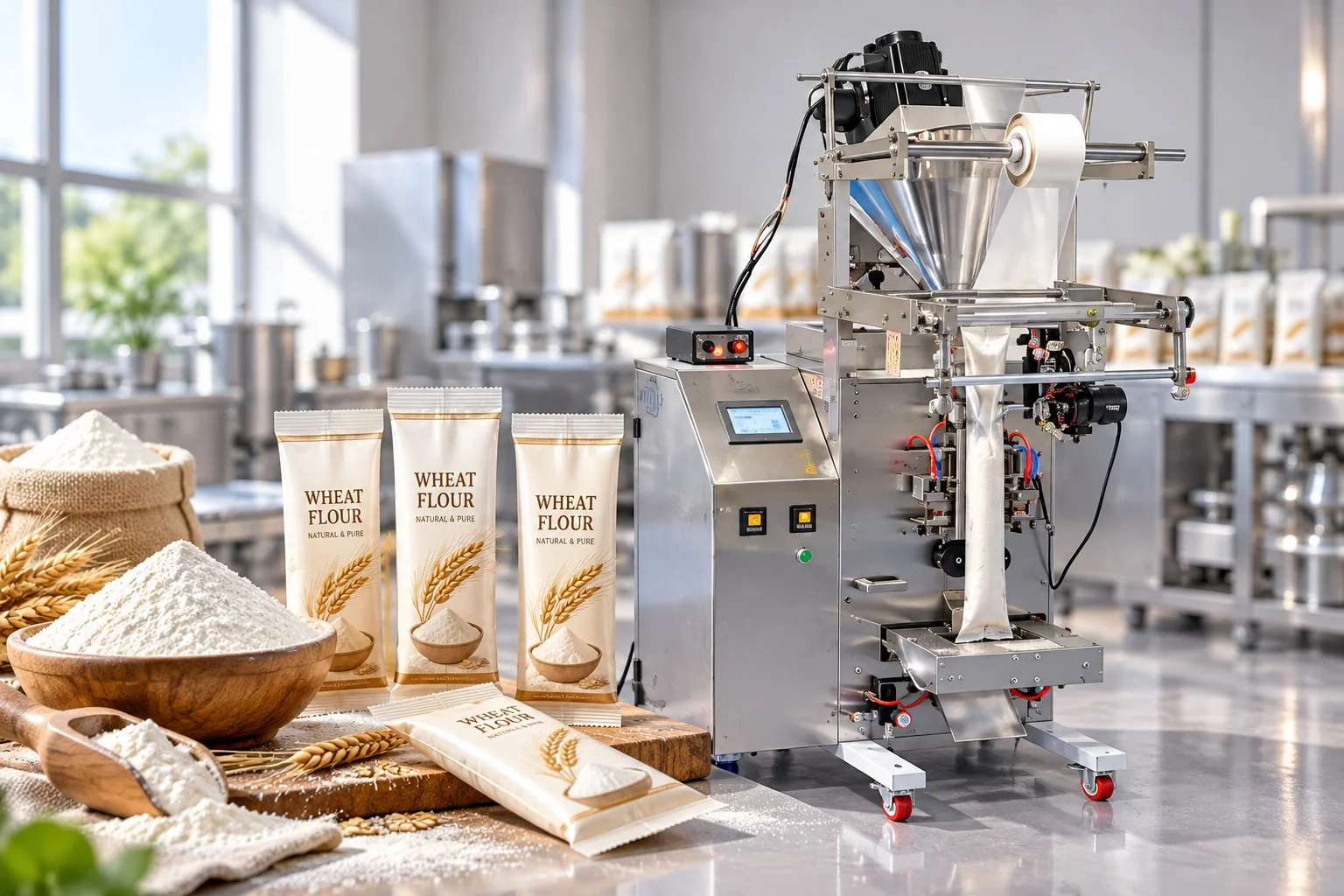
Powders can vary widely in bulk density, flowability, moisture response and tendency to bridge. For a packaging project, the right dosing method therefore depends on the material and the finished pack rather than on a nominal machine speed. This guide uses the supplied factory video as a practical reference: the close-up frame shows a stainless material-contact area and a screw-dosing assembly working above the forming and filling zone.
The purpose is to help purchasing and engineering teams prepare a useful machine brief without replacing a product test. Final tooling, bag dimensions, film construction and control settings should be confirmed after the material and sample film are evaluated.
1. Application Pain Points in Powder Packaging
Powder packaging projects commonly focus on four connected risks: unstable flow, dust around the seal, product retention in the hopper or screw, and a mismatch between the target fill and the selected pouch format. Fine powders may compact or form a bridge, while products with different particle sizes can change the apparent volume during a run.
- Define the product's moisture condition, bulk density and particle profile before selecting the dosing method.
- Separate the filling requirement from the sealing requirement; clean film edges are essential even when the dose itself is stable.
- Use product samples and the required package format for a factory test instead of relying only on a catalogue description.
2. Factory Video: Auger Dosing Process Explanation
The video below is a real factory-material clip selected from Huapai Machinery's shared video library. It provides a close view of the auger dosing area and the material path. The image is intended for process orientation, not as a substitute for a complete acceptance test or a measured production specification.
When reviewing a similar test, check whether the powder enters the screw consistently, whether the discharge path remains clear, and whether the forming and sealing sequence matches the intended bag style. These observations help the engineering team decide what to test next.
3. Step-by-Step Working Principle
- Product loading: Powder enters the hopper or feeding vessel. Agitation or level control may be considered when the product does not flow freely.
- Screw conveying: A selected auger moves a controlled volume of product toward the discharge point. Screw geometry and operating settings are project-dependent.
- Dose release: The measured powder is discharged into the forming tube or prepared pouch, depending on the machine configuration.
- Film forming or pouch opening: Roll film is shaped around a forming collar, or pre-made pouches are opened and positioned for filling.
- Sealing and cutting: The selected sealing jaws close on clean film areas, then the finished pack is separated or discharged.
Every step must be evaluated as one system. A stable screw dose cannot compensate for unsuitable film, an incorrect bag length or powder contamination at the seal.
4. Hygiene and Anti-Breakage Design Considerations
For food, health-related and daily-chemical powders, the design brief should identify all product-contact surfaces, cleaning access and changeover requirements. Stainless contact parts, smooth transitions and accessible joints can simplify inspection, but the required material grade and finish should be confirmed against the product and applicable plant standards.
Powders are not fragile pieces in the same way as snacks, yet they can still create dust, compact in corners or damage a seal when trapped between film layers. Practical safeguards include keeping the dosing outlet aligned with the forming tube, controlling powder spill at the sealing zone, and using a test film with the intended heat-sealing window. These are design considerations to validate during testing, not unconditional performance claims.
5. Pouch Style and Film Material Selection
Start with the package requirements: back-seal pillow pouch, three-side seal, four-side seal or a pre-made pouch. Then match the film to the powder's moisture, oxygen, light and barrier needs. Common project discussions may include PET/PE, OPP/CPP or foil-laminated structures, but the final combination depends on the product, sealant layer, filling environment and local packaging regulations.
- Provide the desired pouch width, length and seal layout.
- Send the film structure, thickness and roll or pouch dimensions when available.
- Explain whether the pack needs a tear notch, zipper, date code, nitrogen option or other feature.
Film samples are especially valuable because heat-sealing temperature, dwell time and pressure are linked to the actual laminate rather than to the machine name alone.
6. General Technical Parameter Table
| Suitable materials | Powders whose flow and density can be evaluated in a product test; final suitability is material-specific. |
|---|---|
| Dosing method | Auger screw dosing, with screw geometry and settings selected for the product and target fill. |
| Bag formats | Back-seal, three-side seal, four-side seal or pre-made pouch configurations, subject to the selected machine. |
| Film requirement | Heat-sealable film or laminate compatible with the chosen sealing system; confirm by sample testing. |
| Contact materials | Specify required stainless material-contact construction and finish with the engineering team. |
| Optional functions | Date coding, dust management, nitrogen flushing, feeding, conveying or inspection functions may be evaluated per project. |
| Unconfirmed items | Fill range, output, accuracy, power and dimensions must be confirmed from product samples, bag data and the final machine configuration. |
The table intentionally leaves project-dependent figures open. Huapai Machinery should confirm final values after reviewing material samples, target fill and packaging format.
7. Information to Prepare for a Customized Quote
A complete inquiry helps the engineering team recommend a suitable configuration without making assumptions. Please prepare:
- Product name, photos, sample quantity and whether it is cohesive, dusty, oily or hygroscopic.
- Target fill weight, acceptable tolerance and desired production capacity.
- Finished pouch dimensions, bag style and preferred opening or tear features.
- Film or pre-made pouch samples, including material structure and thickness when known.
- Factory power standard, available floor space and upstream or downstream equipment.
- Cleaning, coding, nitrogen, dust-control and inspection requirements.
For a project discussion, send these details together with product and film samples. The powder and granule packing machine range provides a starting point, while the final proposal should follow a material-specific test and configuration review.
Need an Auger Dosing Powder Packaging Review?
Share your powder sample details, target fill, pouch style and film information for a configuration discussion with Huapai Machinery.
Prepare a Project Inquiry