 HUAPAI
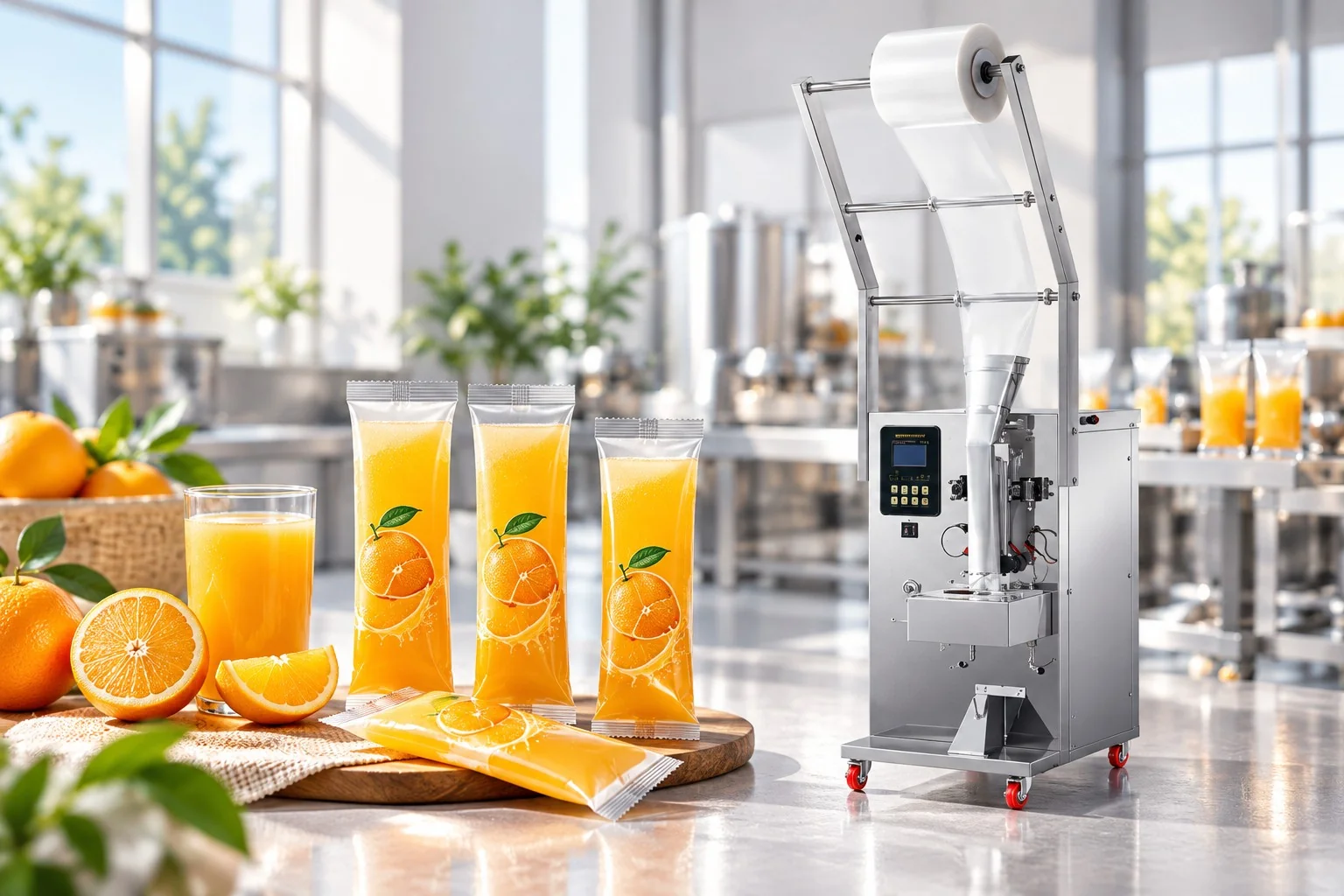
Liquid products can behave very differently during filling. Viscosity, temperature, foam, suspended particles and cleaning requirements all affect the relationship between the pump, film path and sealing system. This guide uses a real Huapai factory video as a process reference: the observed test shows a yellow liquid entering transparent film, followed by longitudinal sealing and toothed end sealing into small pillow-style pouches.
The video is useful for understanding the sequence, but it does not establish a universal output, fill tolerance, seal strength or product suitability. Those items require a material sample, film sample and project-specific test.
1. Application Pain Points in Liquid Pouch Packaging
Liquid pouch projects usually need to control four linked issues: stable dosing, clean seals, film tracking and finished-pouch handling. A liquid that foams or splashes can contaminate the seal area, while a thicker product may need a different pump and a slower filling profile. The pouch must also remain stable as it travels through forming, sealing and discharge.
- Describe viscosity, temperature range, foam tendency and whether the liquid contains particles.
- Define the pouch dimensions and target fill before selecting the forming tube and filling assembly.
- Use a product and film test to review leakage, seal appearance and actual handling behavior.
2. Factory Video: Liquid Filling and Sealing Process
The factory clip below shows transparent roll film being formed around a vertical tube. A liquid is filled into the open pouch section, the longitudinal seal is visible at the center, and the end-sealing jaws create the top and bottom closures. The finished pouches shown in the video are compact and pillow-shaped, while the exact size remains project-dependent.
When reviewing a similar test, watch the product level near the seal, the alignment of the film edges and the release of each filled pouch. These observations help the engineering team decide whether to adjust the filling profile, film tension, sealing settings or discharge arrangement.
3. Step-by-Step Working Principle
- Film unwinding: Roll film is guided toward the forming area. Film width, print registration and tension should be checked against the chosen machine configuration.
- Film forming: A forming set turns the flat web into a tubular pouch shape and establishes the longitudinal sealing area.
- Liquid dosing: The filling system delivers the product into the pouch. Pump type, contact parts and control settings depend on the liquid properties.
- Longitudinal sealing: The vertical seal closes the film around the filled product path. Clean film contact is important for seal consistency.
- End sealing and cutting: Horizontal jaws create the pouch ends and separate the finished unit for discharge or collection.
The sequence operates as one system. A suitable filling pump cannot compensate for an unsuitable laminate, and a good film cannot resolve product splashing caused by an untested filling profile.
4. Hygiene and Anti-Breakage Design Considerations
For food, beverage, cosmetic or daily-chemical liquids, the specification should identify product-contact parts, cleaning access and changeover frequency. Smooth transitions, accessible fittings and a clearly defined drain or cleaning procedure can make routine inspection easier, but the required construction and finish should be agreed with the engineering team and applicable plant standards.
Liquid pouches are also vulnerable to seal contamination, film puncture and mechanical stress during discharge. Practical checks include keeping the product below the sealing zone, avoiding sharp contact with the film and confirming that the conveyor or collection surface does not squeeze the pouch. These are validation points rather than unconditional performance claims.
5. Pouch Style and Film Material Selection
The video shows a transparent film and a back-seal pillow-style pouch. A project may instead require a printed laminate, a high-barrier structure, a three-side seal or a special pouch profile. Select the film after considering the liquid's oxygen, light, moisture, chemical and heat sensitivity, together with the required sealant layer and local packaging rules.
- Provide film structure, thickness, roll width, print direction and sealing-layer information when available.
- Confirm whether the pack needs a date code, tear notch, easy-open feature or special shape.
- Send film samples because sealing temperature, dwell time and pressure depend on the actual laminate.
6. General Technical Parameter Table
| Observed application | Liquid filled into transparent roll film and formed into compact pillow-style pouches in the supplied factory video. |
|---|---|
| Packaging process | Vertical form-fill-seal sequence with film forming, liquid dosing, longitudinal sealing, end sealing and cutting. |
| Suitable liquids | Products whose flow, viscosity, temperature and cleaning requirements can be evaluated in a material test; suitability is product-specific. |
| Film requirement | Heat-sealable film or laminate compatible with the selected forming and sealing system; confirm by sample testing. |
| Contact construction | Specify product-contact material, surface finish, hose and pump requirements with the engineering team. |
| Optional functions | Date coding, liquid-level control, feeding, mixing, conveyor or inspection functions may be evaluated per project. |
| Unconfirmed items | Fill range, output, accuracy, power, pouch dimensions and seal strength must be confirmed from samples and final configuration. |
No project-dependent figures are assumed in this guide. Final values should follow a product, film and machine test.
7. Information to Prepare for a Customized Quote
A useful inquiry gives the engineering team enough context to recommend a filling and sealing configuration without guessing. Prepare:
- Liquid name, photos, sample quantity, viscosity information and temperature range.
- Target fill weight or volume, acceptable tolerance and expected production capacity.
- Finished pouch width, length, seal style and opening or tear requirements.
- Film or pre-made pouch samples, including structure and thickness when known.
- Factory power standard, available floor space and upstream or downstream equipment.
- Cleaning, coding, mixing, feeding, inspection and collection requirements.
For a project discussion, send these details with product and film samples. The liquid packing machine range provides a starting point, while the final proposal should follow a material-specific test and configuration review.
Need a Liquid Pouch Packaging Review?
Share your liquid sample details, target fill, pouch style and film information for a configuration discussion with Huapai Machinery.
Prepare a Project Inquiry