 HUAPAI
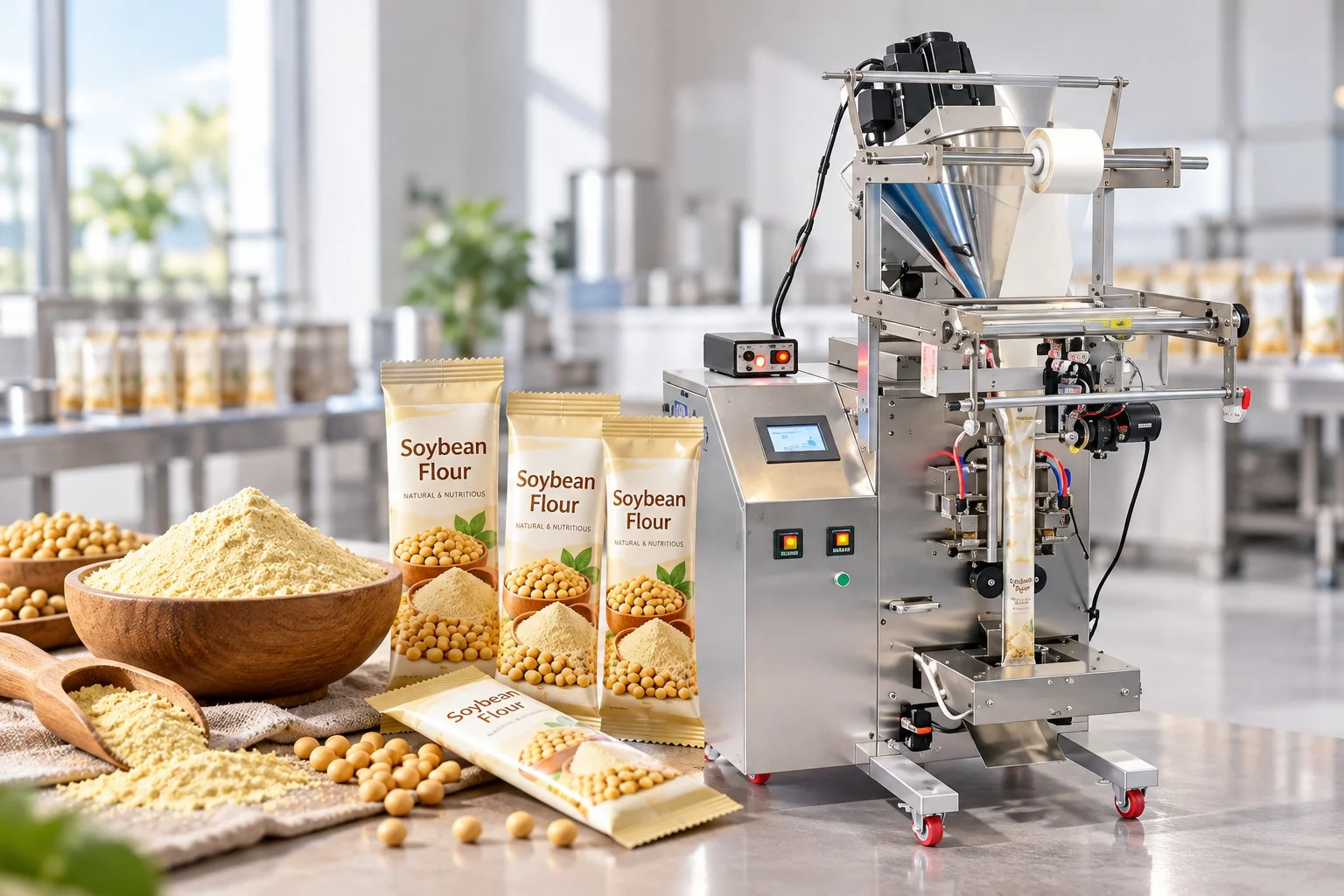
Fine powders often present bridging, irregular density, and dust dispersion challenges during automated packaging. In vertical form-fill-seal packaging systems, the dosing hopper configuration plays a critical role in maintaining consistent material flow. This guide examines an inclined auger powder packaging machine test observed in the Huapai factory, highlighting the rotary agitation mechanism, screw feeding dynamics, and practical engineering validation steps.
The observations and process breakdowns below are intended to assist B2B procurement managers and packaging engineers in preparing project specifications without relying on unverified performance claims.
1. Application Pain Points in Powder Dosing & Sachet Packaging
Powder packaging projects commonly face three operational challenges: inconsistent bulk density inside the hopper, bridging over the screw intake, and airborne dust interfering with heat-sealing surfaces. Non-free-flowing powders (such as starch, matcha, protein powders, and chemical additives) require continuous mechanical conditioning to ensure repeatable volumetric dosing.
- Define powder bulk density, moisture level, particle size distribution, and flowability characteristics.
- Specify whether powder tends to cake, bridge, or generate static charge during conveying and agitation.
- Conduct sample testing to evaluate dosing repeatability, dust control, and sealing integrity.
2. Factory Video: Transparent Hopper Agitation & Auger Feeding
The factory video below demonstrates a vertical powder packaging unit equipped with a transparent hopper cover. Inside the hopper, horizontal rotary agitation arms continuously turn through yellow powder material, preventing bridging and ensuring consistent material supply into the vertical auger screw assembly below. The dosed powder is then directed into the formed film tube for sachet sealing.
Key checkpoints when evaluating this video include the smooth rotary sweep of the agitation blades, the absence of powder accumulation along the conical hopper walls, and the steady discharge into the downspout.
3. Step-by-Step Working Principle
- Hopper Material Infeed: Bulk powder is loaded into the upper stainless steel conical hopper.
- Rotary Agitation: Motor-driven agitator blades rotate continuously to break up lumps and prevent bridging above the screw throat.
- Auger Screw Metering: A precision auger screw rotates by a predetermined angle or step count to meter the exact powder volume into the discharge tube.
- Film Web Forming: Roll film is guided through forming shoulders into a tubular envelope around the filling tube.
- Sealing & Separation: Longitudinal and transverse heated sealing jaws close the sachet seams and cut the finished pack for collection.
The agitation speed, auger pitch, and sealing dwell time must be synchronized according to material bulk density and film thickness.
4. Hygiene and Anti-Contamination Design Considerations
For food, pharmaceutical, and specialty chemical applications, quick disassembly and thorough cleaning of powder-contact surfaces are essential. Stainless steel contact parts (typically SUS304 or SUS316) with smooth internal welds reduce residue buildup between product batches.
Dust extraction ports and enclosed hopper designs minimize ambient particulate release, protecting mechanical drive components and maintaining a clean production environment. Seal jaw cleanliness should be verified to prevent fine powder entrapment in heat seals.
5. Pouch Style and Film Material Selection
Auger-dosed powders can be packaged into three-side seal sachets, four-side seal packs, back-seal pillow pouches, or stick packs depending on the forming collar tooling. Film selection should align with powder barrier requirements:
- Moisture-sensitive powders require high-barrier laminates (e.g., PET/AL/PE, PET/VMPET/PE, or Kraft/AL/PE).
- Heat-seal layer thickness must be adequate to ensure strong hermetic seals even if minimal dust touches the seal area.
- Film roll width and eye-mark tracking should be verified with production samples.
6. General Technical Parameter Table
| Observed Material | Dry powder material handled via hopper agitation and auger screw metering in factory demonstration. |
|---|---|
| Dosing Mechanism | Rotary agitation blades combined with precision auger screw dosing assembly. |
| Hopper Configuration | Conical stainless steel hopper with transparent observation cover and quick-release clamps. |
| Packaging Format | Vertical form-fill-seal sachet packaging (three-side seal, back-seal, or four-side seal tooling options). |
| Contact Parts | Food-grade stainless steel (SUS304 / SUS316 options available upon specification). |
| Optional Integration | Dust suction shroud, date coder, nitrogen flushing, vacuum feeder, and finished pack conveyor. |
| Unconfirmed Items | Target fill weight, operating speed (bags/min), dosing accuracy, and electrical standard depend on project configuration. |
Exact parameters require product sample testing, bulk density measurements, and tooling selection.
7. Information to Prepare for a Customized Quote
To help the engineering team configure a suitable powder packaging system, prepare the following project details:
- Product name, bulk density (g/cm³), moisture percentage, and sample photos.
- Target dosing weight per sachet (e.g., 5g, 20g, 100g, 500g) and required tolerance.
- Preferred sachet dimensions (width × length) and seal configuration.
- Packaging film structure, thickness, roll diameter, and sample material.
- Target output capacity (bags per minute or packs per hour).
- Factory electrical specifications (voltage, frequency, phase) and workshop footprint.
Explore our complete powder and granule packaging machine line to compare configurations, or submit a technical inquiry below.
Need a Powder Packaging Machine Consultation?
Send your powder characteristics, target pack size, and production capacity for an engineering assessment with Huapai Machinery.
Prepare a Project Inquiry