 HUAPAI
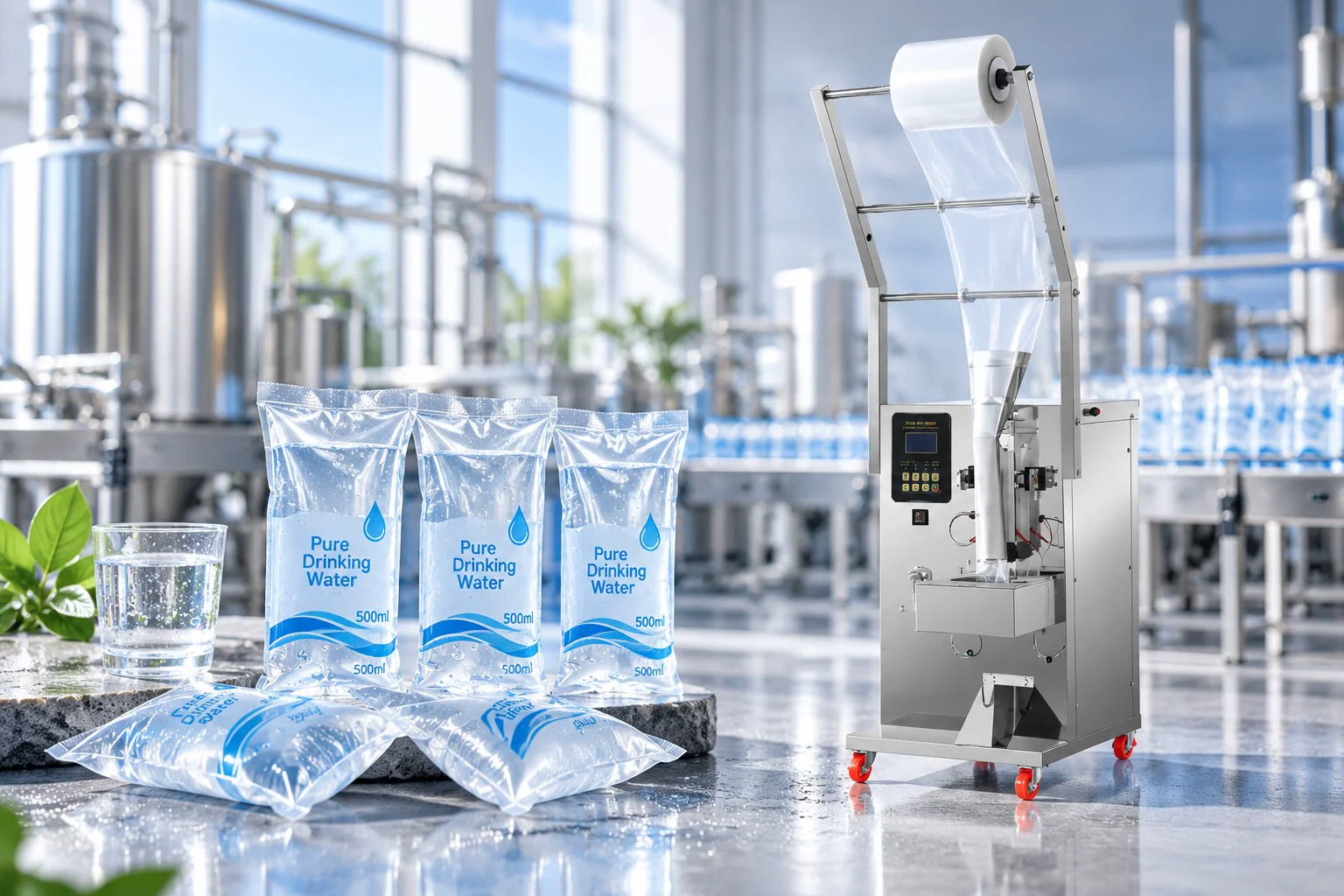
Automated sachet and pouch packaging for drinking water, purified liquids, and aqueous beverages demands exceptional sealing reliability, precise dosing volume, and strict hygienic control. Unlike dry granules or powders, liquid packaging lines must manage hydrostatic pressure, fluid turbulence during dosing, and residual liquid entrapment in the sealing zone to prevent micro-leaks and packaging failure during transit.
Vertical Form-Fill-Seal (VFFS) liquid packaging machines provide an efficient, compact, and economical solution for single-serve water sachets, emergency drinking water pouches, and institutional beverage distribution. This technical guide examines the core operational principles, mechanical former dynamics, sanitary fluid pathways, and equipment configuration factors based on factory testing at Huapai Machinery.
1. Application Pain Points in Liquid & Drinking Water Pouch Packaging
Packaging low-viscosity aqueous products presents distinct physical and operational challenges that packaging engineers must resolve:
- Hydrostatic Splash & Seal Contamination: Rapid liquid discharge into narrow tubular film sleeves can cause droplets or foam to splash onto inner seal areas. Fluid trapped in the heat-seal seam lowers the bonding temperature and creates channels for pinhole leakage.
- Film Web Slippage & Stretching: Thin polyethylene (PE) or co-extruded barrier films used for water sachets can stretch unevenly under heavy liquid weight if film tension and pulling belts are not precisely synchronized.
- Hermetic Integrity Under Drop Impact: Water pouches must withstand significant hydraulic shock during bulk packing, carton drop tests, and rough transportation without bursting along longitudinal or transverse seams.
2. Factory Video: Vertical Forming Collar, Liquid Injection & Pneumatic Sealing
The operational video below illustrates the continuous packaging cycle of a vertical water pouch machine in the Huapai testing workshop. Single-wound transparent barrier film is drawn downward over a precision stainless steel forming tube. As the film wraps into a cylinder, a pneumatic heat-sealing carriage indexes forward, forming a durable longitudinal back-seam and hermetic horizontal end-seals while purified water is metered directly through the central filling lance.
Key technical highlights visible in the demonstration include the smooth pneumatic jaw actuation, rapid sealing response, bubble-free liquid cutoff, and consistent pouch geometry formed without film distortion.
3. Step-by-Step Working Principle of Vertical Liquid Form-Fill-Seal Machine
- Film Unwinding & Photoelectric Registration: Continuous roll-stock film is unreeled under tension-controlled dancer bars. A high-sensitivity optical sensor reads print registration marks to ensure exact pouch length consistency.
- Collar Former & Tube Shaping: The flat web enters the forming collar shoulder, wrapping seamlessly around the vertical stainless steel filling tube to create a continuous tubular sleeve with uniform overlap.
- Continuous Back-Seam Heating: A vertical heating bar or heated roller mechanism applies calibrated thermal energy and pneumatic pressure to form an airtight longitudinal back seal (pillow style or fin seal).
- Volumetric Liquid Dosing & Anti-Drip Cutoff: A sanitary piston pump or magnetic flow meter injects the exact liquid volume through the inner filling pipe. A pneumatic positive-shutoff nozzle at the bottom prevents trailing drips from contacting the seal area.
- Transverse Sealing, Cooling & Cutoff: Horizontally opposed heat-sealing jaws close to seal the top of the filled water pouch and the bottom of the succeeding pouch simultaneously, followed by an integrated serrated knife cut for individual pouch separation.
Coordinating the liquid dosing valve timing with the sealing jaw cycle prevents liquid sloshing across the sealing line, ensuring 100% hermetic joint integrity.
4. Anti-Leakage, Sanitary Contact & Drip-Free Sealing Engineering
Ensuring hygienic compliance and zero-leakage durability requires specific mechanical engineering safeguards across all fluid-contact and sealing assemblies:
Food-Grade Sanitary Fluid Circuit: All liquid contact surfaces—including the intake manifold, metering cylinders, delivery hoses, and dispensing nozzles—are constructed from sanitary SUS304 or SUS316 stainless steel with polished internal finishes (Ra < 0.4 μm) to prevent bacterial adhesion and simplify Clean-in-Place (CIP) sanitation.
Positive-Shutoff Anti-Drip Nozzles: Spring-loaded or pneumatically actuated check-valves seated at the lower tip of the filling pipe instantly close upon stroke completion, eliminating errant drops that could contaminate the horizontal seal zone.
PID Thermal Regulation & Independent Temperature Zones: Digital PID temperature controllers regulate the longitudinal and transverse sealing bars independently, maintaining steady sealing temperature within ±1°C regardless of ambient fluctuations.
5. Pouch Styles, Film Laminate Structures & Barrier Selection for Liquids
Choosing the correct flexible packaging material ensures adequate mechanical strength, puncture resistance, and environmental barrier properties for liquid contents:
- Single-Layer Low-Density Polyethylene (LDPE): The most cost-effective solution for rapid-turnover drinking water sachets, providing high elasticity and reliable heat sealability.
- Co-Extruded Multi-Layer PE Films (3-Layer / 5-Layer): Incorporates inner carbon black or UV-blocking layers to extend shelf life in sunny climates while enhancing puncture and tensile resistance.
- Laminated Barrier Films (PET/PE, NY/PE, PET/AL/PE): Recommended for flavored beverages, liquid condiments, chemical detergents, and long shelf-life medical saline solutions requiring total oxygen and moisture barrier protection.
- Pouch Format Options: Standard center back-seal pillow pouches, 3-side seal sachets, 4-side seal flat packets, or stick packs depending on market preferences.
6. General Technical Parameter Table
| Applicable Products | Purified drinking water, mineral water, liquid beverages, juices, liquid seasonings, and light chemical liquids. |
|---|---|
| Packaging Format | Vertical Form-Fill-Seal (VFFS) center back-seal pillow pouch, 3-side seal, or 4-side seal sachet. |
| Dosing Method | Sanitary volumetric piston pump or magnetic flow metering system with positive anti-drip nozzle. |
| Sealing Mechanism | Pneumatically driven constant-heat or impulse sealing jaws with independent PID digital temperature control. |
| Contact Material | Food-grade SUS304 stainless steel (SUS316 optional for corrosive or pharmaceutical liquids). |
| Standard Integrated Features | Film unwind tension control, forming collar, optical eye-mark registration, transparent safety guard, pneumatic cutoff. |
| Engineering Variables | Filling volume (50ml–1000ml), packaging speed (bags/min), pouch width/length, and power configuration customized per client line. |
Exact production capacity and specifications depend on liquid viscosity, target fill volume, and film roll specifications.
7. Information to Prepare for a Customized Quote
To receive an accurate engineering proposal and tailored equipment configuration for your liquid packaging project, preparing the following details is recommended:
- Liquid characteristics (purified water, juice, oil, viscous liquid, foaming tendency, or corrosive ingredients).
- Target filling volume per pouch (e.g., 100ml, 250ml, 500ml, 1000ml) and required dosing tolerance.
- Pouch dimensions (flat bag width and length) and preferred pouch style (pillow pouch vs. 3-side seal).
- Packaging film structure (pure PE, PET/PE, co-extruded multi-layer) and roll core diameter.
- Target production output (pouches per minute or daily production volume targets).
- Facility power supply specifications (voltage, frequency, phase) and compressed air availability.
Explore our specialized liquid packing machines and sauce packaging systems, or consult directly with our technical team below.
Ready to Configure Your Liquid Packaging Line?
Send your liquid volume requirements, pouch dimensions, and production capacity goals to Huapai Machinery for a dedicated engineering assessment.
Request Engineering Consultation